


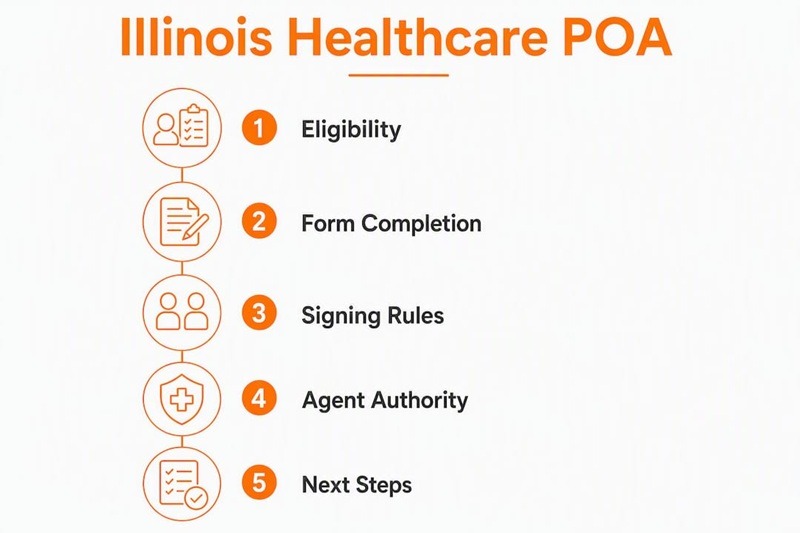
A valid Illinois healthcare power of attorney requires three things: a willing, eligible agent; a completed statutory short form (or a compliant equivalent); and your signature in front of at least one qualified witness. That’s it. Do those three things correctly and your chosen person has the legal authority to speak for you when you cannot speak for yourself.
Here’s the checklist to get started right now:
- Choose your agent. Pick someone 18 or older who is not your current treating physician, who understands your values, and who is willing to take on the responsibility. Name at least one successor agent as a backup.
- Complete the Illinois statutory short form. Download the official IDPH PDF from the Illinois Department of Public Health. Fill in your full name, your agent’s name and contact information, and any specific instructions or limitations you want included.
- Sign before required witnesses, then distribute copies. Sign and date the form in front of at least one eligible witness (who also signs). Notarization is not legally required but is strongly recommended. Give signed copies to your agent, your primary care physician, and any hospital where you receive regular care.
Illinois Legal Aid Online offers a plain-language walkthrough of the same process if you prefer a guided format before you fill out the form.
What is a healthcare POA and how does it differ from a financial POA?
A healthcare power of attorney (HPOA) names a specific person, your agent, to make medical decisions on your behalf when you are unable to make them yourself. That’s the whole job. It does not touch your bank accounts, your property, or your business interests. Those fall under a separate general or financial power of attorney.
The distinction matters in practice. A financial POA gives your agent authority over assets. An HPOA gives your agent authority over your body: treatment decisions, surgery consent, access to your medical records, and discharge planning. The two documents serve entirely different functions, and having one does not substitute for the other.
- HPOA: Controls medical decisions and access to health records; activates based on the timing you choose (immediately or upon incapacity).
- General/financial POA: Controls property, finances, and legal transactions; governed by a separate Illinois statute.
- Living will: Records your preferences about life-sustaining treatment in writing, but does not name a decision-maker.
One point that trips up Illinois residents: you do not need to use the word “durable” in your HPOA. In many other states, a POA must be labeled “durable” to remain valid after incapacity. Illinois law does not require that label — the document’s effect during incapacity depends on how it is written, not on a specific word appearing in the title.
Note: If you already have a financial POA, do not assume it covers medical decisions. Review both documents with your agent so they know exactly which one applies in which situation.

Picture this: you are hospitalized after a car accident and cannot communicate. Without an HPOA, the hospital turns to Illinois’s statutory surrogate hierarchy to find someone to authorize treatment. That hierarchy may not reflect who you would have chosen. An HPOA puts your person in that room instead.
Who can create an HPOA in Illinois, and who can be your agent?
To sign an Illinois HPOA, you must be at least 18 years old and mentally competent at the time of signing. “Competent” means you understand what the document is, what authority you are granting, and who you are naming. A diagnosis of a chronic illness does not automatically disqualify you — what matters is your capacity at the moment you sign.
Your agent must also be at least 18 and capable of making decisions. Illinois law disqualifies one category of person outright: your current treating health care provider. A physician or nurse who is actively providing your care cannot serve as your agent. Beyond that statutory restriction, the choice is yours.
What to look for in an agent:
- Trustworthiness. Will this person honor your wishes even under family pressure?
- Availability. Can they be reached quickly in an emergency, including at 2 AM?
- Proximity. Are they close enough to get to a hospital when needed?
- Willingness. Have they explicitly agreed to take on this role?
- Understanding. Do they know your values around quality of life, not just your medical history?
- Successor agent. If your first choice cannot act, who steps in? Name at least one backup.
The Illinois statutory short form includes space for both a primary agent and successor agents. Under Illinois law, only one agent may act at a time, so the succession order matters.
One thing many people skip: the conversation. Before you sign anything, sit down with your chosen agent and walk through your actual wishes. What does “quality of life” mean to you? Under what circumstances would you want aggressive treatment versus comfort-focused care? An agent who has heard your answers directly will be far more effective than one who is guessing.
Note: If you are in a blended family or an unmarried partnership, Illinois default surrogate rules may bypass your partner entirely. Naming them as your agent in a signed HPOA is the most direct way to fix that.
When can your agent act, and what limits can you place on their authority?
Your agent’s authority begins at the moment you specify in the document. Illinois gives you two main options:
- Effective immediately: Your agent can act as soon as the document is signed, even while you are still competent. You retain your own decision-making authority; the agent’s role is concurrent.
- Effective only upon incapacity: Your agent’s authority activates only when a physician determines you lack the capacity to make or communicate decisions. This is the more common choice.
When the document is written to depend on incapacity, a physician makes that determination. The form does not require a specific number of physicians or a formal hearing. One attending physician’s written determination is typically sufficient to trigger the agent’s authority.
Key points on scope and limits:
- Your agent can consent to or refuse any medical treatment, including life-sustaining measures, unless you restrict that authority in the document.
- You may limit the agent’s authority to specific conditions, specific types of treatment, or specific facilities.
- You may include preferences about organ donation, mental health treatment, or long-term care placement directly in the form.
- Concise, concrete language matters. Vague phrases like “extraordinary measures” create disputes. Named interventions or clear value statements do not.
That kind of language gives your agent and your medical team something specific to work with. It also reduces the chance that a family member challenges the agent’s decision by claiming the instructions were ambiguous.
How to complete, sign, and make your Illinois HPOA valid

Use the Illinois statutory short form. It includes the statutory notice, agent power descriptions, and witness signature blocks. Following it step by step satisfies Illinois’s execution requirements and reduces the chance a hospital will push back.
Step-by-step signing checklist
- Fill in full names and contact information for yourself, your primary agent, and at least one successor agent.
- State when the POA becomes effective — immediately or upon incapacity. Initial the appropriate line.
- Add any specific instructions or limitations in the space provided. Keep language concrete.
- Initial your choices about life-sustaining treatment if you want those preferences documented in the HPOA itself.
- Sign and date the form in front of your witness(es). Your signature must come first.
- Witness(es) sign after you. Each witness must be present when you sign.
Witness rules
Illinois requires at least one witness for the statutory short form. Witnesses must be 18 or older and cannot be:
- The agent named in the document
- A close relative (spouse, parent, sibling, or child)
- Your attending physician or any health care professional currently treating you
- The operator or employee of a health care facility where you are a patient
Notarization
Notarization is not legally required in Illinois for an HPOA to be valid. That said, notarizing is strongly recommended. Hospitals and admissions staff are more likely to accept a notarized document without question, especially in an emergency when there is no time to verify witness signatures. Traditional notary services in Illinois have a small fee under state guidance — a minor cost for significantly less friction.
Notarization cost: Illinois notary fee for traditional services is $5. Remote/electronic notarization is recognized under the Illinois Power of Attorney Act when the required standards are met.
Electronic signing
755 ILCS 45/4-10 permits electronic signatures and technology-neutral electronic documents under certain standards. If you sign electronically, the same witness requirements apply. Remote notarization is also recognized when an electronically present notary meets the statutory standards.
Distribution and storage
A signed HPOA sitting in a drawer at home does almost nothing. Hospitals and clinicians will not consult your agent unless there is a legible copy in your chart or your agent can produce the document on the spot.
- Give the original (or a certified copy) to your primary agent.
- Give copies to each successor agent.
- Hand a copy to your primary care physician and ask them to add it to your chart.
- Upload it to your patient portal (MyChart, if your hospital uses it) under advance directives.
- Keep a legible photo of the signed document on your phone.
- Bring the original to hospital admissions any time you are admitted.
Where do you download the official Illinois HPOA form?
The authoritative source is the Illinois Department of Public Health statutory short form PDF. It is free, current as of July 30, 2021, and includes the statutory notice and execution instructions built in.
Illinois Legal Aid Online offers a guided Easy Form walkthrough that walks you through each field before generating a completed document. That option works well if you want prompts and plain-language explanations as you go.
A few cautions about other sources:
- Third-party template sites often add non-statutory language, miss witness requirements, or use outdated forms. A document that looks official but fails to meet Illinois execution standards may be rejected by a hospital or challenged by a family member.
- Generic “durable POA” forms from other states may not satisfy Illinois requirements and should not be used.
- A nonstatutory form can still be valid in Illinois if it meets the execution requirements under 755 ILCS 45/4-10, but using the state’s own short form eliminates most of the guesswork.
The IDPH PDF is the safest starting point. Download it, fill it out, and follow the signing checklist above.
How do you revoke or change your Illinois HPOA?
You can revoke an HPOA at any time while you are competent. The most common method is signing a written revocation or executing a new HPOA that explicitly states it revokes all prior documents. Either approach works; the key is notifying the right people immediately.
Revocation checklist:
- Prepare a written revocation (or a new HPOA that states it supersedes prior forms). Sign it with at least one eligible witness.
- Notify your agent in writing. An agent who does not know the document has been revoked may still attempt to act on it.
- Retrieve or clearly mark old copies as revoked. Write “REVOKED” across the face of any copies you can recover.
- Give updated copies to your doctors, your hospital, and any facility where the old form was on file. Ask them to remove the prior version from your chart.
- Upload the new document to your patient portal and confirm the old version has been replaced.
If you sign a new HPOA, note on the new form itself that it revokes all prior healthcare powers of attorney. Hospitals follow the most recent valid directive in your chart, so the date on the document matters. Keep it visible.
On agent resignation: an agent may resign by notifying you in writing. If your primary agent resigns or becomes unable to act, your successor agent steps in automatically under the terms of the document. This is why naming a successor agent at signing is not optional — it is the only way to guarantee continuity.
How does an HPOA relate to a living will, POLST, and other advance directives?
An HPOA names a person to make decisions. A living will records your preferences about specific treatments. A POLST is a physician’s medical order for patients who are already seriously ill. They are not duplicates; they work together.
Illinois recognizes four types of advance directives: the HPOA, the living will, the Mental Health Treatment Preference Declaration, and the POLST. Each serves a distinct purpose.
| Document | Purpose | When it applies | Who completes it | Typical use case |
|---|---|---|---|---|
| HPOA | Names an agent to make medical decisions | When you lack decision-making capacity (or immediately, if written that way) | You (the principal) | Anyone 18+ who wants a trusted person to speak for them |
| Living will | Records preferences about death-delaying procedures | Terminal condition or permanent unconsciousness | You (the principal) | Anyone with strong preferences about end-of-life treatment |
| Mental Health Treatment Preference Declaration | Records preferences about mental health treatment | Mental health crisis or incapacity | You (the principal) | Anyone with a mental health history or specific psychiatric treatment preferences |
| POLST | Medical order for life-sustaining treatment | Serious illness; patient is already at elevated risk | Physician and patient together | Seriously ill patients, nursing home residents, hospice patients |
Recommended sequencing:
- Sign your HPOA first. It covers the broadest range of situations and is the most universally useful document.
- If you have strong preferences about life-sustaining treatment, add a living will. The two documents complement each other; the HPOA agent can reference the living will when making decisions.
- If you are seriously ill or in a care facility, ask your physician about completing a POLST. It functions as an actual medical order, not just a statement of preference.
- Once all documents are signed, add them to your chart together so providers see a consistent, complete picture.
Practical attorney tips to make your HPOA effective in real situations
For most Illinois residents, the statutory short form is sufficient. You do not need an attorney to complete it. But there are situations where professional review pays for itself: blended families, unmarried partners, LGBTQ+ couples whose wishes may face family resistance, anyone with complex medical preferences, or situations where long-term care planning intersects with incapacity planning.
Whether you use an attorney or not, these practices make the difference between a document that works and one that gets ignored:
- Name successor agents. Under Illinois law, only one agent may act at a time. If your primary agent is unavailable, a document with no backup leaves a gap.
- Include a values statement. A sentence or two about what quality of life means to you gives your agent something to stand on when family members disagree. “I value independence and clear communication over longevity at any cost” is more useful than a list of procedures.
- Avoid vague language. “Extraordinary measures” means different things to different physicians. Name specific interventions or use clear conditional language instead.
- Keep one clearly dated, current document. Multiple versions floating around different providers create confusion. Every time you update the HPOA, replace the old copies everywhere they exist.
- Prepare your agent for the conversation. Give them a short script: “I am [name]’s healthcare agent under a signed Illinois HPOA. Here is a copy. I am authorized to make decisions on their behalf.” That framing moves things faster in an emergency.
Pro Tip: If you are part of a blended family or an unmarried partnership, estate planning built around your actual family structure reduces the risk that a biological relative challenges your agent’s authority. An HPOA is a strong document, but pairing it with a broader estate plan makes it harder to contest.
The Illinois Health Care Surrogate Act sets a default decision-making hierarchy that runs: guardian, spouse, adult children, parents, siblings, grandchildren, close friend. An unmarried partner does not appear on that list. An HPOA bypasses the hierarchy entirely by naming your person directly. For chosen families, that is not a technicality — it is the whole point.
Key Takeaways
A valid Illinois healthcare power of attorney requires a completed statutory short form, at least one eligible witness, and immediate distribution to your agent and health providers.
| Point | Details |
|---|---|
| Use the official IDPH form | Download the Illinois statutory short form PDF from IDPH — it includes execution instructions and reduces hospital pushback. |
| Witness rules are strict | Your witness must be 18+, not your agent, not a close relative, and not your treating physician or care facility staff. |
| Notarization is optional but smart | Illinois does not require notarization, but the $5 traditional notary fee is worth it to avoid administrative delays in emergencies. |
| Distribution is non-negotiable | Give copies to your agent, successor agents, primary care physician, and hospital admissions; upload to MyChart if available. |
| Chosenestateplanning offers flat-fee HPOA packages | For blended families, unmarried partners, or complex situations, Chosenestateplanning provides flat-fee document review and full estate planning packages in Illinois. |
Why Illinois residents keep putting this off, and why that’s a problem
Most people who have not completed an HPOA are not opposed to the idea. They just have not gotten around to it. What we see, again and again, is that the delay is not about reluctance — it is about not knowing exactly what to do next. The form sits on a to-do list. The conversation with the agent never happens. Then a hospitalization occurs, and the hospital is left working through a surrogate hierarchy that does not reflect anyone’s actual wishes.
For families that do not fit the traditional mold — unmarried partners, blended households, LGBTQ+ couples, adult children caring for aging parents — that default hierarchy is not just inconvenient. It can actively exclude the person who should be making decisions. An HPOA is the fastest, most direct fix available under Illinois law.
The statutory short form is free and takes less than an hour to complete. For most people, that is enough. For situations involving complex family dynamics, long-term care planning, or specific medical preferences that need careful drafting, a flat-fee attorney review adds a layer of assurance that the document will hold up when it matters.
Chosen Estate Planning makes flat-fee estate planning straightforward for Illinois families
If you have read this far and you are thinking about your own family’s situation, Chosen Estate Planning is built for exactly this. The firm offers flat-fee estate planning packages for Illinois residents, with a process designed to be clear, jargon-free, and inclusive of families that traditional estate planning often overlooks.
There are no hourly billing surprises. Chosenestateplanning specifically serves blended families, LGBTQ+ couples, unmarried partners, and aging parents who need documents that reflect their actual lives, not a default legal framework that was not written with them in mind.
The next step is simple: book a discovery call to talk through your situation and find out which documents you actually need. If you want to explore the full scope of Illinois estate planning first, this estate planning overview covers the core documents and how they work together.
Useful sources to open right now
Start with the IDPH PDF — it contains the statutory language that hospitals recognize, and filling it out directly reduces the chance of any administrative challenge.
- Illinois HPOA Statutory Short Form (IDPH PDF) — Use this first. The official state form with execution instructions built in.
- Illinois Legal Aid Online: How to Set Up a Power of Attorney for Health Care — Plain-language guided walkthrough, including witness rules and distribution guidance.
- Illinois Legal Aid Online: HPOA Common Questions (FAQ) — Covers notarization, agent eligibility, and revocation in plain English.
- 755 ILCS 45/4-10 — Illinois Compiled Statutes (statutory short form and execution standards) — The legal text governing the HPOA form, electronic signatures, and execution requirements.
- IDPH Advance Directives page — Overview of all four Illinois advance directives (HPOA, living will, Mental Health Treatment Preference Declaration, POLST) and facility notification requirements.
This article provides general legal information about Illinois healthcare powers of attorney. It is not legal advice. Confirm current requirements with the Illinois Department of Public Health, the Illinois Compiled Statutes, or a qualified Illinois attorney before relying on any document for medical decision-making.