


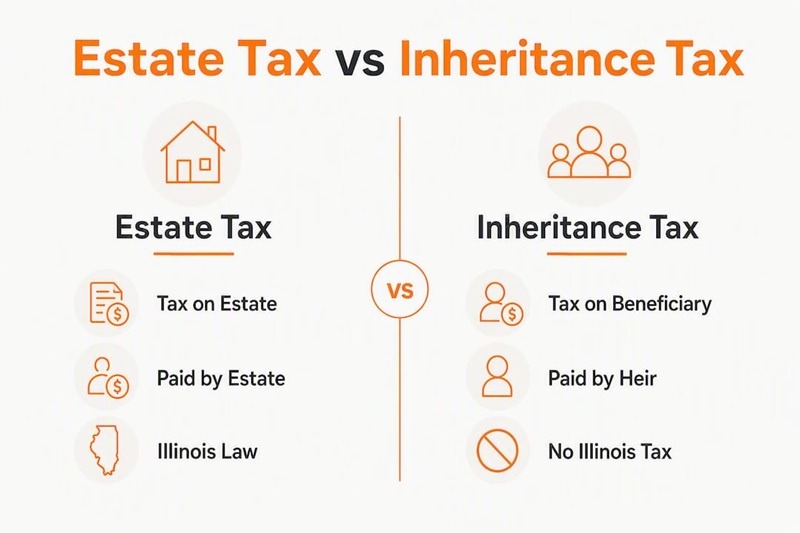
Illinois does not have a beneficiary-level inheritance tax. What it does have is a state estate tax that is paid by the estate itself before any assets reach heirs. That distinction matters practically: if you inherit money from an Illinois estate, you will not receive a separate tax bill from the state. The estate pays first, and you receive what remains. The primary authority for this tax is the Illinois Attorney General’s office, not the Illinois Department of Revenue (though IDOR confirms the AG handles administration). Estates that exceed the state exclusion threshold must file Form 700, the Illinois Estate and Generation-Skipping Transfer Tax Return, with the Attorney General within a specified time period after the date of death.
The exclusion amount is $4,000,000. Estates at or below that figure owe no Illinois estate tax. Estates above it can owe meaningful sums, and because the exclusion works as a cliff rather than a credit, crossing it by even a small amount triggers tax on the full taxable estate. Legislative proposals can change both the exclusion and the rates, so always verify the rules against the decedent’s specific date of death before relying on any fixed number.
Note: If a decedent’s gross estate is anywhere near $4 million, start gathering asset valuations and beneficiary designation documents immediately. Waiting until the nine-month deadline approaches leaves little room for appraisals, disputes, or corrections.
Does Illinois have an inheritance tax or an estate tax?
The two terms are often used interchangeably, but they describe different legal mechanisms.
- Inheritance tax is assessed against the beneficiary based on what they receive. The heir pays it, and the rate sometimes varies by the heir’s relationship to the decedent.
- Estate tax is assessed against the estate before distribution. The executor pays it from estate assets, and the heirs receive whatever is left.
Illinois imposes an estate tax, not an inheritance tax. Beneficiaries in Illinois do not owe a state-level tax simply because they received an inheritance. The estate itself bears the liability, which means the executor or administrator handles the filing and payment.
One common source of confusion: inherited retirement accounts such as IRAs or 401(k)s are generally not taxed as income at the moment of inheritance, but distributions taken from those accounts afterward can carry federal income tax consequences. That is a federal income tax issue, not an Illinois estate tax issue, and the two should not be conflated.
For deaths occurring before certain dates, older filing and release rules may apply. The Attorney General’s website archives instruction fact sheets by year of death, so executors dealing with older estates should check the specific sheet for the relevant period rather than relying on current guidance.
What is the Illinois estate tax exclusion, and who is actually affected?
The Illinois exclusion amount is $4,000,000, measured against the decedent’s gross estate after including adjusted taxable gifts made during life. Estates at or below that amount owe nothing to the state. Estates above it face the full rate schedule on the taxable portion.
The $4 million exclusion is a threshold, not a credit. Crossing it by $1 does not mean owing tax only on that $1. It means the estate tax rules apply to the entire taxable estate.
What counts toward the gross estate is broader than most people expect:
- Probate assets (real estate, bank accounts, personal property titled in the decedent’s name alone)
- Retained interests in trusts or property where the decedent held certain rights
- Life insurance proceeds where the decedent owned the policy or the estate is the named beneficiary
- Retirement accounts, depending on ownership structure and beneficiary designations
- Jointly held property, typically included at a proportional share
The practical verification step: pull the date of death, list every asset the decedent owned or controlled, and get current-value appraisals for real estate, business interests, and any non-liquid holdings. That gross estate number determines whether Form 700 is required at all.

What are the Illinois estate tax rates, and how does the math work?
Illinois estate tax rates range from approximately 0.8% to 16%, applied on a graduated schedule based on estate size. The lowest marginal rate applies to the first taxable dollars above the exclusion; the top rate of 16% applies to the largest estates. Because the exclusion is a cliff, an estate just above $4 million faces tax on the entire taxable base at the applicable marginal rates, not just on the excess.
Rate range: 0.8% to 16%. Even a modest overage above the $4 million threshold can produce a five-figure tax bill because the schedule applies to the full taxable estate, not just the amount over the line.
Sample calculation: estate of $5 million
This is an illustrative estimate only. Actual liability depends on deductions, credits, asset valuations, and current law. Use official forms or consult an attorney for exact figures.
- Determine gross estate: $5,000,000 (total fair market value of all included assets)
- Subtract allowable deductions: debts, funeral expenses, administrative costs, and charitable bequests (assume $200,000 in this example)
- Taxable estate: $4,800,000
- Compare to exclusion: $4,800,000 exceeds $4,000,000, so the estate tax rules apply
- Apply the rate schedule: the tax is calculated on $4,800,000 using the graduated Illinois rate table (not just on the $800,000 excess)
- Estimated Illinois estate tax: a rough estimate at blended marginal rates on a $4.8 million taxable estate falls in the range of several hundred thousand dollars, though the exact figure requires the official Form 700 computation
The cliff effect is the most important concept here. An estate of $3,999,999 owes zero. An estate of $4,000,001 owes tax calculated on the full taxable estate. That asymmetry is exactly why planning before death matters far more than scrambling after.
Who files, what forms are required, and when is the deadline?
The executor or administrator of the estate is responsible for filing and paying the Illinois estate tax to the Illinois Attorney General. Questions about this can be directed to the Attorney General’s office.
| Item | Detail |
|---|---|
| Filing form | Form 700 (Illinois Estate and Generation-Skipping Transfer Tax Return) |
| Filing deadline | Nine months from the date of death |
| Filed with | Illinois Attorney General’s office |
| Threshold for filing | Gross estate exceeds $4,000,000 (after adjusted taxable gifts) |
| Federal return attachment | Required when a federal estate tax return is filed; attach to Form 700 |
| Forms download | illinoisattorneygeneral.gov |
Form 700 covers decedents dying on or after January 1, 2023. For earlier deaths, the Attorney General archives prior-year instruction fact sheets on its website. Executors dealing with estates from 2022 or earlier should pull the fact sheet specific to that year.
Executor action checklist:
- Obtain the certified death certificate
- Compile a complete asset inventory with current fair market values
- Gather all beneficiary designation forms (life insurance, retirement accounts, TOD/POD accounts)
- Collect deeds, account statements, and any prior estate planning documents
- Download Form 700 from the Attorney General’s website
- Confirm whether a federal estate tax return (IRS Form 706) is also required
- Contact the AG’s office or an estate attorney if valuation questions arise
How does Illinois estate tax differ from federal estate tax?
The federal and Illinois estate taxes run on parallel tracks, but the differences between them are significant enough that assuming one covers the other is a common and costly mistake.
- Exemption gap: The federal estate tax exemption is substantially higher than Illinois’s $4 million exclusion. Many estates that owe nothing federally may still owe Illinois estate tax.
- Who files where: Federal Form 706 goes to the IRS; Illinois Form 700 goes to the Illinois Attorney General. Both may be required for the same estate.
- Portability: Federal law allows a surviving spouse to inherit the deceased spouse’s unused federal exemption. Illinois does not allow portability of the unused state exclusion. A spouse who dies without using planning strategies to deploy their $4 million exclusion loses it entirely.
- Deductions and credits: The calculations differ in structure. Illinois uses its own rate schedule and does not simply piggyback on the federal computation.
The portability gap is the single most underappreciated difference. A married couple with a combined estate of $7 million might assume they are fine because each spouse’s $4 million exclusion covers the whole estate. Under Illinois law, that assumption is wrong if the first spouse’s exclusion is not properly deployed through planning.
How can you reduce or avoid Illinois estate tax?
Several strategies can legitimately reduce an estate’s exposure. None of them are last-minute fixes; all require planning while the person is alive and capable of making decisions.
- Lifetime gifting: Illinois does not have a separate gift tax, and the federal annual gift tax exclusion (currently $18,000 per recipient per year under federal law) allows assets to leave the estate without triggering federal gift tax. Systematic gifting over years can meaningfully reduce a gross estate below the Illinois threshold.
- Irrevocable trusts: Assets transferred to a properly structured irrevocable trust are generally removed from the grantor’s taxable estate. The trade-off is loss of direct control over those assets.
- Credit shelter trusts (bypass trusts): Designed specifically for married couples to address Illinois’s no-portability rule. The first spouse to die funds a trust up to the $4 million exclusion amount; that trust’s assets are not included in the surviving spouse’s estate. Both spouses’ exclusions are effectively used.
- Qualified terminable interest property (QTIP) elections: Another marital planning tool that allows assets to pass to a surviving spouse while still qualifying for the marital deduction, with flexibility on how the remainder passes at the surviving spouse’s death.
- Charitable giving strategies: Outright charitable bequests reduce the taxable estate dollar-for-dollar. Charitable remainder trusts and charitable lead trusts offer more complex structures that can benefit both heirs and charities.
- Life insurance in an irrevocable life insurance trust (ILIT): Keeps life insurance proceeds out of the taxable estate while providing liquidity to pay estate taxes or replace assets transferred to other trusts.
Note: A credit shelter trust is often the single highest-impact move for Illinois married couples with combined estates above $4 million. Without one, the first spouse’s exclusion is gone the moment assets pass outright to the survivor.
The timing point deserves emphasis. Because the exclusion is a cliff, a $200,000 difference in estate value can mean the difference between a zero tax bill and a substantial one. Removing volatile or appreciating assets from the estate early, before they grow past the threshold, is far more effective than trying to reduce value after the fact.

What happens without a will in Illinois, and who is at risk?
Illinois intestate succession follows a strict statutory formula under the Probate Act. If a decedent dies without a will, the state decides who inherits, and the result often surprises families.
- A surviving spouse and descendants split the estate equally (50/50 under the statute)
- If there is no surviving spouse, descendants inherit everything per stirpes
- Stepchildren do not inherit unless they were legally adopted
- Unmarried partners receive nothing under intestacy, regardless of the length or depth of the relationship
- LGBTQ+ couples who are legally married are treated the same as any married couple, but unmarried LGBTQ+ partners face the same gap as any other unmarried partner
Dying without a will also means the probate court controls the process, which adds time, cost, and public exposure to what could otherwise be a private transfer. Creditor claims are resolved during probate, and if the estate lacks liquid assets to pay both creditors and estate taxes, executors may be forced to sell property under pressure.
For blended families, the intestacy rules are particularly unforgiving. A stepparent’s biological children from a prior relationship may inherit assets the stepparent intended for stepchildren, or vice versa, simply because no formal documents existed to express a different intent.
Note: Beneficiary designations on retirement accounts, life insurance, and bank accounts override a will and bypass probate entirely. Reviewing and updating those designations is one of the fastest, lowest-cost ways to protect intended heirs, especially after a marriage, divorce, or birth.
Assets that commonly bypass probate and pass directly to named individuals include POD and TOD accounts, jointly held property with right of survivorship, and assets held in a funded revocable living trust. Knowing which assets are in each category is the first step in any estate review.
Key Takeaways
Illinois imposes a state estate tax, not a beneficiary-level inheritance tax, with a $4,000,000 cliff exclusion and rates from 0.8% to 16% that apply to the full taxable estate once the threshold is crossed.
| Point | Details |
|---|---|
| Estate tax, not inheritance tax | Illinois taxes the estate before distribution; heirs do not receive a separate state tax bill. |
| $4 million cliff exclusion | Estates above $4,000,000 owe tax on the full taxable estate, not just the excess over the line. |
| No portability for spouses | Illinois does not allow a surviving spouse to inherit the deceased spouse’s unused exclusion; credit shelter trusts address this gap. |
| Form 700, nine-month deadline | The executor files with the Illinois Attorney General within nine months of the date of death. |
| Chosenestateplanning | Offers flat-fee, inclusive estate planning in Chicago for blended families, LGBTQ+ couples, and unmarried partners navigating Illinois estate tax exposure. |
The part most Illinois families get wrong
Most people who discover they have an Illinois estate tax problem find out too late to do much about it. The estate is already in probate, the assets are already titled the wrong way, and the surviving spouse is staring at a tax bill that a credit shelter trust would have eliminated entirely.
The federal exemption creates a false sense of security. Families with $5 or $6 million in assets assume they are below the federal threshold and stop thinking about estate taxes. Illinois’s $4 million cliff catches them anyway, and the no-portability rule means the first spouse’s death can waste an entire exclusion if the estate plan does not account for it.
The other pattern worth naming: blended families who rely on intestacy to “sort it out.” It does not sort it out. The statute distributes assets to biological descendants and legal spouses. Stepchildren, long-term unmarried partners, and chosen family members get nothing unless a document says otherwise. That is not a technicality; it is the law as written.
The most reliable planning priorities for Illinois residents are straightforward: get an accurate picture of the gross estate, remove volatile or appreciating assets from the taxable estate before they grow past the threshold, and use formal documents to protect everyone you actually intend to protect.
Chosen Estate Planning: flat-fee Illinois estate planning for modern families
Illinois estate tax planning is not a one-size-fits-all problem, and neither is our approach. We offer flat-fee estate planning in Chicago covering revocable living trusts, wills, powers of attorney, healthcare directives, beneficiary coordination, and other estate planning structures with pricing that eliminates the uncertainty of hourly billing.
To get started, book a discovery call or download the Chosen Family Estate Plan e-book for a plain-language overview of your options. Bring your asset list, your beneficiary designations, and any existing documents. The first conversation is about understanding your situation, not selling you a package.
This article provides general information about Illinois estate tax law and is not legal advice. Tax thresholds, rates, and filing requirements can change. Verify current rules with the Illinois Attorney General’s office or a qualified Illinois estate-planning attorney before making decisions.
Authoritative sources and further reading
Verify all figures and download official forms directly from primary sources. Legislative changes can affect exemption amounts and rates, so always confirm the rules that apply to the decedent’s specific date of death.
- Illinois Attorney General: Estate Taxes — primary filing authority, Form 700 download, and office contact (217-524-5095)
- Form 700: Illinois Estate and Generation-Skipping Transfer Tax Return — official return for decedents dying on or after January 1, 2023
- Illinois Estate Tax Instruction Fact Sheet — confirms the $4,000,000 exclusion and explains the cliff threshold
- 35 ILCS 405: Illinois Estate and Generation-Skipping Transfer Tax Act — the governing statute
- 755 ILCS 5/2-1: Illinois intestate succession rules — statutory distribution formula for estates without a will
- Illinois Department of Revenue: Does Illinois have an inheritance/estate tax? — confirms AG jurisdiction and provides contact information
- IRS Form 706: United States Estate Tax Return — federal filing requirement for large estates; separate from Illinois Form 700
Recommended
- What Happens If You Die Without an Estate Plan in Illinois
- Avoiding Probate in Illinois | How to Keep Your Family Out of Court
- Feeling Left Out of Probate? Illinois Beneficiary Rights, Explained – Chosen Estate Planning LLC
- Wills and Trusts in Illinois: Understanding the Key Differences and Why Both Matter