


Digital Assets Estate Planning: Give Executors Access
A digital assets estate plan makes sure your online accounts, cryptocurrency, and monetized profiles can actually be found and lawfully managed after you’re gone. Start with two moves: build an inventory of what exists, and grant a fiduciary explicit legal authority to access it through your will, trust, or power of attorney. Secure your credentials now, because an executor doesn’t automatically get access to your accounts just because you named them.
- Most states follow the Revised Uniform Fiduciary Access to Digital Assets Act, known as RUFADAA, which prioritizes platform tools for digital access but requires estate documents for legal authority over digital assets.
- An accurate inventory listing service names, locations, recovery methods, income status, and instructions must be stored securely and updated annually.
- Password managers’ emergency access features are useful but do not replace the need for explicit legal authority granted through estate planning documents.
- Never include passwords or private keys in wills, but instead reference a separate, encrypted memorandum stored securely outside the probate record.
- Assets like cryptocurrency and monetized accounts need specific language in estate documents and may require separate handling, such as multi-signature wallets or business entity structures.
What Counts as a Digital Asset (And Why It’s Not Just Photos)
People hear “digital assets” and picture old Facebook photos or an email archive nobody wants. That’s a fraction of the picture. A real digital estate includes financial accounts, cryptocurrency wallets, business infrastructure, and anything generating recurring income or holding contractual value.
Here’s what typically falls under the umbrella:
- Financial and transactional accounts: banking apps, PayPal, Venmo, brokerage logins, and cryptocurrency exchanges or wallets
- Content and creative property: photos, manuscripts, music files, and cloud storage libraries
- Business infrastructure: domain names, websites, email lists, and software licenses
- Access credentials: private keys, two-factor authentication devices, and password manager vaults
- Monetized profiles: YouTube channels, Instagram accounts with brand deals, Etsy shops, Patreon pages
- Points and subscriptions: airline miles, hotel loyalty points, streaming subscriptions with prepaid credits
The distinction that trips people up is legal transferability versus operational access. You might legally own the copyright to a manuscript sitting in a dead Google Drive account, but if nobody has the login and Google won’t hand it over without the right documentation, that ownership is theoretical. Families lose five figures in cryptocurrency because the only record of a wallet’s seed phrase lived in the owner’s head. Business owners lose customer email lists worth real revenue because nobody thought to write down where the export file lived.
Building an Inventory Your Executor Can Actually Use
An inventory that just lists “Gmail, Chase, Coinbase” is worthless to whoever inherits the job of closing out your digital life. Useful inventories capture enough detail that a stranger with legal authority could act on them without guessing.
For each asset, record:
- Service name and account identifier (username or email tied to the account, not the password itself)
- Where the credential lives (which password manager vault, not the credential itself)
- Backup or recovery method (recovery phrase location, backup codes, linked recovery email)
- Monetization status (does this generate income, and who currently receives payouts)
- Specific instructions (should this account be closed, memorialized, transferred, or sold)
Store the inventory itself in an encrypted vault or your password manager’s secure notes feature, not in a document sitting on your desktop. Reference the vault’s existence in a separate memorandum that your estate documents point to, rather than embedding account details directly in a will (more on why in a later section).
Update the inventory at least once a year, and immediately after opening new financial accounts, switching password managers, or acquiring cryptocurrency. Tell your executor or successor trustee where the memorandum lives, not what’s in it. AARP’s guidance on digital estate planning recommends the same inventory-first approach, paired with enabling whatever legacy tools a platform offers.
Pro Tip: Set a recurring calendar reminder tied to a date you already track, like your annual tax filing. Reviewing your digital inventory alongside your taxes means you’re already in “financial housekeeping” mode, and you’re far less likely to skip it.
The Legal Rules Behind Who Gets Access
Most states have adopted some version of the Revised Uniform Fiduciary Access to Digital Assets Act, known as RUFADAA. It sets a three-tier priority system that governs who can access a deceased person’s digital accounts: platform-provided tools come first, your estate planning documents come second, and a platform’s default terms of service come last if neither of the first two exists.
That order matters more than most people realize. If you set up Google’s Inactive Account Manager, that instruction generally overrides a vague line in your will. But if you never touched the platform’s tools, a well-drafted trust or power of attorney with explicit digital-asset language usually beats the platform’s default “we delete everything after 90 days of inactivity” policy.
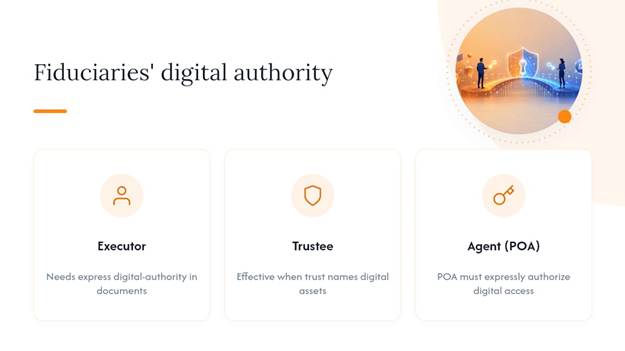
Vague authority isn’t authority. Naming an executor in a will doesn’t mean they can log into your accounts. An executor has no automatic right to access online accounts unless the deceased explicitly consented through platform settings or estate documents naming digital assets specifically.
Even with the right documents, operational friction is real. Two-factor authentication tied to a deceased person’s phone number can lock out even a legally authorized executor for weeks. Private messages often stay off-limits regardless of legal authority, since platforms treat communications differently from account data. And logging in with someone else’s password, even with good intentions, can brush up against federal computer-access law, which doesn’t carve out an exception for grieving family members.
The language that actually works grants your executor, trustee, or agent express authority to “access, control, conduct, continue, or terminate” your digital accounts, and it names digital assets specifically rather than relying on generic property clauses.
Password Managers and Platform Legacy Tools, Compared
Two categories of tools exist to bridge the access gap, and they solve different problems.
Password managers with emergency access or shared vault features let you designate a trusted contact who can request access after a waiting period you control, typically anywhere from a few hours to several days. This handles the “how do they actually log in” problem without you handing over your master password today.
- Set up emergency access in your password manager and designate your named executor or a backup contact
- Enable every platform legacy feature available: Apple’s Digital Legacy program, Facebook’s Legacy Contact setting, and Google’s Inactive Account Manager
- Understand that legacy tools are mostly built for memorialization and narrow tasks, not full administrative control
- Weigh third-party “digital legacy” services carefully. Handing a company your master credentials creates a new privacy exposure, even if the service promises encryption
The gap between what these tools promise and what they deliver is bigger than most people expect. Legacy features on major platforms are built primarily for memorialization, not full account takeover. A Facebook Legacy Contact can pin a tribute post and update a profile photo; they generally cannot read years of private messages. Treat platform tools as one layer of a plan, never the whole plan.
Where to Put Access Instructions (And Where Never To)
Never write passwords, PINs, or cryptocurrency private keys directly into your will. A will becomes a public probate record in most jurisdictions once it’s filed with the court, which means anyone can pull it and read exactly what’s in it. Estate planning guidance from legal educators is consistent on this point: a will should point to where access information lives, never contain it.
The workable structure looks like this:
- Draft a separate memorandum listing account names and where credentials are stored, kept outside the court file
- Reference that memorandum by name in your will or trust, without quoting its contents
- Store the memorandum in an encrypted vault or with your password manager’s secure sharing feature
- Use a revocable living trust rather than a will alone when privacy or continuous management matters, since trust administration typically stays out of the public record and can operate immediately without waiting for probate
- Confirm your named trustee has formally accepted the role and knows where the memorandum and vault credentials are held
A trust earns its keep here specifically because of that privacy layer. If you’re managing a monetized YouTube channel or an active crypto portfolio, a trust lets your successor trustee keep the business running without a probate court schedule dictating the timeline. Illinois residents can see how wills, trusts, and powers of attorney fit together as a system rather than standalone documents.
Insight: If you’re naming a successor trustee for the first time, have a direct conversation with them before you finalize documents. A trustee who doesn’t know they’ve been named, or doesn’t know where the memorandum lives, is functionally the same as having no plan.
Cryptocurrency, NFTs, and Monetized Accounts Need Different Handling
Standard estate language wasn’t written with private keys and monetized social profiles in mind, and treating them like a bank account creates real gaps.
- Self-custodied crypto lives or dies with the private key. If you hold your own keys rather than using an exchange, a multi-signature setup, where control splits across several keys with a threshold requirement to move funds, solves the tension between security and inheritability better than handing one heir a single seed phrase. For example, you might hold one key, your spouse holds a second, and someone you trust holds a third, so any two can approve a transfer and your family still has a way in if one key is lost or you pass away.
- Custodial exchange accounts function more like traditional financial accounts, with designated beneficiary options in some cases, though access still routes through the platform’s own verification process
- Tax treatment follows property rules: the IRS treats cryptocurrency as property, so your heirs’ cost basis resets to fair market value on your date of death, which matters enormously if they plan to sell
- Domain names, email lists, and monetized channels transfer more cleanly when owned by a business entity rather than an individual. Structuring online business assets inside an LLC with a clear operating agreement avoids the mess of transferring dozens of individual account logins one by one
If cryptocurrency or a monetized online business makes up a meaningful piece of your estate, generic digital-asset language in a template will isn’t enough. These assets need their own line items and, often, their own succession mechanism.
Your Digital Estate Checklist, in Order
Work through this roughly in sequence, front-loading the steps that protect you if something happens tomorrow.
- Build your inventory, secure your password manager, enable every legacy tool your platforms offer
- Update your power of attorney to include digital-asset authority, add a digital-asset clause to your will or trust, name a digital executor or confirm your trustee can handle this role
- Review the inventory annually, and update it immediately after opening new accounts, switching financial platforms, or acquiring cryptocurrency
| Timeframe | Action | Why it matters |
| Immediate | Build asset inventory | An executor can’t manage what they can’t find |
| Immediate | Enable platform legacy tools | Covers memorialization even before documents are updated |
| Near-term | Add digital-asset clause to will/trust | Grants the legal authority platform tools alone don’t provide |
| Near-term | Update power of attorney | Covers incapacity, not just death |
| Ongoing | Annual review | New accounts and crypto holdings need to be added |
If incapacity, not death, worries you most, your power of attorney needs the same digital-asset language your will does. Gaps in incapacity planning show up in digital access just as often as they show up in financial accounts.
Why Most Digital Estate Advice Gets the Order Backward
Most articles on this topic lead with tools: get a password manager, turn on Google’s Inactive Account Manager, done. That’s backward. Tools solve operational access, but they don’t solve legal authority, and conflating the two is a big mistake.
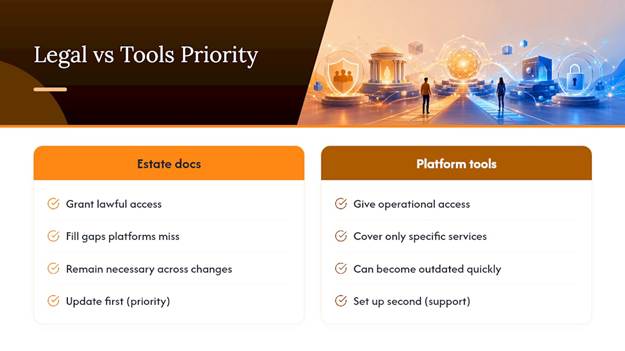
A password manager’s emergency access feature can hand your executor a login. It cannot make that access lawful if your will never granted digital-asset authority in the first place. RUFADAA’s own tiered structure proves the point: platform tools sit at the top of the priority list, but estate documents are what fill every gap platforms don’t cover, which is most of them.
The conventional wisdom also underrates how fast this stuff changes. A crypto wallet you open this year isn’t in a plan you wrote five years ago. If your estate plan hasn’t been touched since before you started using a password manager or bought your first cryptocurrency, it has a hole in it right now, not hypothetically. Prioritize the legal document update first, the tool setup second. Do both, but do them in that order.
Get Your Digital Assets Covered by an Estate Plan That Actually Names Them
Chosen Estate Planning is the flat-fee alternative to piecing together generic will templates and hoping the boilerplate covers your crypto wallet or your monetized Instagram account. Where template services leave you guessing whether their standard “personal property” clause reaches your digital assets, Chosen Estate Planning will take inventory of your assets and, where appropriate, draft the specific language RUFADAA rewards: explicit fiduciary authority naming your accounts, your executor, and your instructions.
This matters most if you hold cryptocurrency outside an exchange, or run a monetized online business or content channel, since these situations create the biggest gaps in default estate law.
To get started, book a discovery call or download the Chosen Family Estate Plan e-book for a plain-language overview of your options.
Sources
- Digital executor: managing online assets in modern estate planning – American Bar Association (2026)
- Govinfo
- Digital assets – IRS
- Remember digital assets in your will – AARP
This article is general information, not legal advice, and reading it doesn’t create an attorney-client relationship. Consult a qualified attorney about your own circumstances before acting on anything here.
Recommended